
Call us toll free:
8619709992541 [email protected]
Jctprint Machinery Co., Ltd
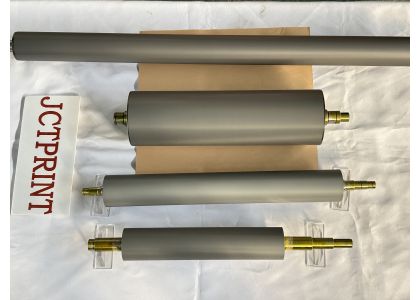
Two anilox rollers have the same 800 LPI specification, but why do they produce different printing results?
One roller delivers consistent color and smooth ink transfer, while the other produces lighter colors, uneven ink density or requires frequent adjustments.
The reason is simple: LPI alone does not determine anilox roller performance.
Cell volume (BCM), cell geometry, engraving accuracy and roller condition all influence how ink is transferred during flexographic printing.
Understanding these differences can help printers choose the right ceramic anilox roller and improve printing consistency.
LPI (Lines Per Inch) indicates the number of engraved cells per linear inch on an anilox roller.
It describes the cell screen ruling, but it does not tell you exactly how much ink the roller can carry.
For example, two ceramic anilox rollers may both have 800 LPI, but their cell volumes and engraving structures can be different.
As a result, they may deliver different amounts of ink to the printing plate.
This is why LPI should always be considered together with BCM and cell structure, rather than being used as the only selection criterion.
BCM (Billion Cubic Microns) is commonly used to express anilox cell volume per square inch.
Cell volume influences the amount of ink available for transfer.
In general:
Higher BCM: Greater ink-carrying capacity, often suitable for applications requiring heavier ink coverage.
Lower BCM: Lower ink-carrying capacity, which may be appropriate for finer printing applications.
However, higher BCM does not automatically mean better printing quality.
The correct cell volume depends on the printing material, ink system, plate characteristics and required print result.
Two rollers with identical LPI but different BCM values can therefore produce noticeably different color densities.
Besides LPI and BCM, the shape and structure of engraved cells can affect ink transfer.
Important factors include cell depth, opening dimensions, wall structure and engraving angle.
Different cell geometries can influence how ink fills the cells and how effectively it is released during printing.
For example, conventional hexagonal cells and specialized high-transfer cell structures may perform differently under the same printing conditions.
Even when two rollers have similar nominal LPI and BCM values, differences in cell geometry may influence actual ink transfer.
This is especially relevant for flexible packaging, label printing and other applications requiring consistent color reproduction.
Anilox roller performance depends not only on the selected specifications but also on how accurately the cells are manufactured.
If cell dimensions or volumes vary across the roller surface, ink transfer may become less uniform.
High-precision laser engraving helps produce consistent cell structures and controlled cell volumes.
At JCTPRINT, we use ALE laser engraving equipment to manufacture customized ceramic anilox rollers.
The engraving specifications can be selected according to the customer's printing application, including LPI, BCM, engraving angle and cell structure.
Consistent engraving quality is particularly important for high-speed CI flexo and wide-web printing applications.
Sometimes two anilox rollers originally had the same specifications but no longer perform the same way.
This may be caused by differences in their operating condition.
Blocked cells: Dried ink and contamination can reduce the effective cell volume, resulting in weaker or uneven ink transfer.
Worn cells: Long-term wear or improper cleaning can change the cell structure and reduce ink-carrying capacity.
Surface damage: Scratches, ceramic damage or other surface defects may affect ink distribution and printing consistency.
A roller may still be marked as 800 LPI, but its actual ink transfer performance may have changed significantly.
Regular cleaning and cell inspection can help identify these problems before they cause serious production issues.
Visual inspection alone cannot accurately determine the condition of microscopic anilox cells.
Professional cell inspection equipment can help evaluate cell geometry, depth and volume.
JCTPRINT uses AniCAM cell inspection equipment to check engraved cell structures and verify important specifications.
Cell inspection helps identify differences that may not be visible on the roller surface.
When comparing anilox rollers from different manufacturers, it is useful to ask how cell volume and engraving consistency are inspected.
For replacement rollers, comparing the measured specifications of the existing roller with the intended new roller can also help prevent unnecessary printing adjustments.
If you are purchasing a new or replacement ceramic anilox roller, do not compare products based on LPI alone.
Consider the complete engraving specification, including BCM, cell geometry and printing application.
For an existing flexographic press, the current roller specification is a useful starting point.
If your printing requirements have changed, it may be necessary to review the cell volume or engraving structure before ordering a replacement.
Providing your machine model, current roller specifications and printing requirements allows the manufacturer to evaluate a suitable solution.
JCTPRINT manufactures custom ceramic anilox rollers and anilox sleeves for different flexographic printing applications.
Our products are used in CI flexo printing, wide-web flexible packaging, label printing, corrugated printing and coating applications.
With ALE laser engraving and AniCAM cell inspection, we focus on accurate engraving specifications and consistent cell quality.
Whether you need a replacement roller or a new engraving specification, our technical team can help confirm your requirements.
Send us your machine model, existing roller dimensions, LPI, BCM or technical drawing.
JCTPRINT can review your printing requirements and provide a customized anilox roller solution and quotation.


