
Call us toll free:
8619709992541 [email protected]
Jctprint Machinery Co., Ltd
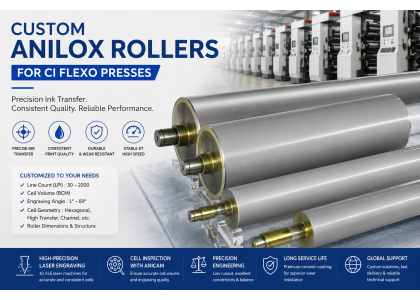
In CI flexographic printing, consistent ink transfer is essential for maintaining stable color density, sharp print details, and efficient high-speed production. As one of the core components of the ink transfer system, the anilox roller directly affects print quality, ink consumption, and overall press performance.
However, different CI flexo presses, printing materials, inks, and production requirements need different anilox specifications. A standard anilox roller may not always provide the required ink volume or fit the press correctly.
Custom anilox rollers are manufactured according to the press model, printing application, and required ink transfer performance. With the correct roller dimensions, line count, cell volume, engraving angle, and cell geometry, printers can achieve more stable and repeatable printing results.
CI flexo presses are widely used for high-speed printing on flexible packaging materials. Multiple printing units are arranged around a central impression cylinder, allowing accurate registration and stable web control during production.
Because CI presses often operate at high speeds and handle demanding multi-color printing jobs, even small variations in ink transfer can affect the final print result.
An unsuitable or poorly manufactured anilox roller may cause:
Uneven color density
Excessive or insufficient ink transfer
Pinholes and poor solid coverage
Dirty printing and dot gain
Color variation during long production runs
Increased ink consumption and material waste
Frequent press adjustments and production downtime
A custom anilox roller is designed to match the specific requirements of the CI flexo press and printing process, helping maintain consistent ink transfer throughout production.
Selecting an anilox roller involves more than choosing a line count. Several technical parameters must work together to achieve the required print performance.
The roller body, shaft, bearing positions, overall length, face length, and mounting structure must match the CI flexo press accurately.
Incorrect dimensions may cause installation problems, excessive vibration, unstable rotation, or premature wear.
For custom production, customers can provide:
An existing roller drawing
Original roller specifications
CI flexo press brand and model
Detailed roller dimensions
Photos of the existing roller and mounting structure
Line count determines the number of engraved cells on the roller surface and is usually measured in LPI or LPCM.
Lower line counts generally provide higher ink volume and are commonly used for heavy coatings, white ink, adhesives, and high-density solid printing.
Higher line counts are generally selected for fine text, small dots, detailed graphics, and high-quality process printing.
The correct line count should be selected according to the printing plate, ink type, substrate, and required print result.
Cell volume determines how much ink the anilox surface can carry and transfer.
If the volume is too low, the print may appear weak or lack sufficient coverage. If the volume is too high, excessive ink may cause dirty printing, dot gain, slow drying, or increased ink consumption.
For CI flexo printing, line count and cell volume should always be evaluated together rather than selected independently.
The engraving angle influences ink release and may affect the interaction between the anilox pattern, printing plate, and screen design.
A 60-degree hexagonal cell structure is widely used in flexographic printing because it provides a balanced combination of cell density, ink capacity, and transfer consistency.
However, different engraving angles and cell structures can be customized for specific printing and coating requirements.
Different applications may require different cell geometries.
Common options include:
Standard hexagonal cells
High-transfer cell structures
Elongated cells
Channel-type engraving
Customized cell geometries for special inks or coatings
The most suitable geometry depends on ink viscosity, transfer volume, press speed, substrate, and printing application.
CI flexo presses are used for a wide range of flexible packaging products. Each application may require a different anilox configuration.
Films such as PE, PP, PET, BOPP, and other flexible packaging materials require stable and controlled ink transfer.
A properly customized anilox roller can help achieve:
Consistent color density
Smooth solid coverage
Clear graphics and fine details
Reduced color variation during long runs
High-quality process printing requires accurate control of ink film thickness.
An anilox roller with the appropriate line count and cell volume helps reduce excessive dot gain while improving fine text, halftones, and image reproduction.
White ink and high-density colors generally require higher ink transfer than process colors.
Customized cell volume and engraving geometry can improve opacity and solid coverage while helping control excessive ink consumption.
CI flexo equipment may also be used to apply varnish, adhesive, primer, or functional coatings.
These applications often require larger cell volumes or specialized engraving structures to achieve uniform coating weight across the web.
Ceramic anilox rollers are widely used in CI flexo presses because of their wear resistance, engraving accuracy, and long service life.
During manufacturing, a ceramic coating is applied to the roller surface and processed to achieve the required surface quality. The cells are then engraved using high-precision laser engraving equipment.
A high-quality ceramic anilox roller can provide:
Consistent cell geometry
Stable ink transfer
High surface hardness
Strong wear resistance
Reliable performance during high-speed production
Longer service life under proper operation and maintenance
The quality of the ceramic coating and laser engraving directly affects cell consistency and long-term ink transfer performance.
A custom anilox roller should not only match the required specifications but also maintain high mechanical accuracy.
Important inspection factors include:
Roller diameter
Overall length and face length
Shaft and bearing dimensions
Surface finish
Total indicated runout
Concentricity
Dynamic balance
Cell depth and geometry
Actual cell volume
Low runout and accurate dynamic balance are especially important for high-speed CI flexo presses. Excessive vibration may affect ink transfer, print stability, bearing life, and overall press performance.
At JCTPRINT, custom anilox rollers are manufactured through controlled production and inspection processes. Advanced laser engraving equipment is used to produce consistent cell structures, while cell measurement systems help verify the actual engraving quality and ink-carrying capacity.
Before ordering a custom anilox roller, it is helpful to provide detailed information about the press and printing application.
Recommended information includes:
CI flexo press brand and model
Roller drawing or complete dimensions
Required LPI or LPCM
Required BCM or cell volume
Engraving angle
Preferred cell geometry
Ink type
Printing substrate
Printing speed
Main application, such as process printing, white ink, solid printing, varnish, adhesive, or coating
If the required engraving specifications are not available, the application details can be used to evaluate a suitable anilox configuration.
JCTPRINT manufactures customized anilox rollers and anilox sleeves for various CI and wide-web flexographic printing systems.
Custom solutions are available for equipment from brands such as:
W&H
BOBST
Comexi
Uteco
F&K
KBA
The roller dimensions and engraving specifications are customized according to the actual press configuration and production requirements.
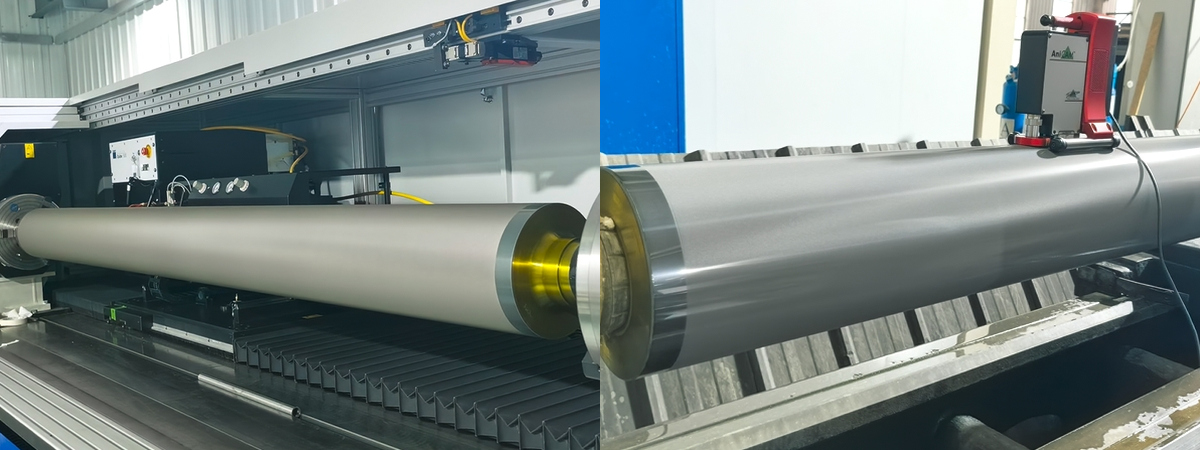
With more than 20 years of manufacturing experience, JCTPRINT provides customized anilox solutions for flexographic printing and industrial coating applications.
Our manufacturing capabilities include:
Ten ALE high-precision laser engraving machines
Custom line counts, cell volumes, engraving angles, and cell geometries
Anilox solutions for CI and wide-web flexo presses
AniCAM cell inspection for engraving and volume verification
Precision machining and dynamic balancing
Custom production based on drawings, dimensions, or press specifications
Global shipping and remote technical support
From roller structure to engraving specifications, each anilox roller is manufactured according to the customer's equipment and application requirements.
The performance of a CI flexo press depends on accurate and consistent ink transfer. Choosing a custom anilox roller with the correct dimensions, line count, cell volume, engraving angle, and cell geometry can help improve print consistency, reduce ink waste, and support stable high-speed production.
Whether the application involves flexible film, process printing, white ink, solid colors, varnish, adhesive, or industrial coating, the anilox specification should be selected according to the actual production requirements.
Looking for a custom anilox roller for your CI flexo press?
Send us your press model, roller drawing, dimensions, LPI, BCM, or printing application. JCTPRINT will help evaluate the requirements and provide a customized anilox solution.


