
Call us toll free:
8619709992541 [email protected]
Jctprint Machinery Co., Ltd
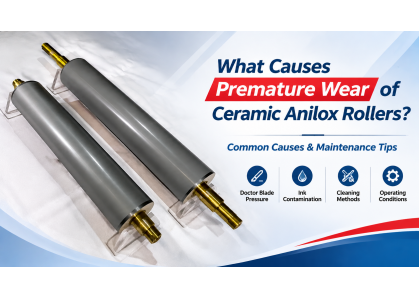
Ceramic anilox rollers are designed for long-term use in flexographic printing. However, some printing companies experience premature wear, reduced ink transfer or damage to the ceramic surface.
Why does this happen?
In many cases, the problem is not simply the roller's manufacturing quality. Doctor blade pressure, cleaning methods, ink contamination and daily operating conditions can all affect the service life of a ceramic anilox roller.
Understanding these factors can help printing companies reduce unnecessary wear, maintain consistent ink transfer and avoid premature replacement.
The doctor blade works directly against the anilox roller to remove excess ink from its surface.
If the blade pressure is too high, it can increase friction between the blade and the ceramic surface.
Over time, improper blade pressure or incorrect blade installation may contribute to surface wear and damage.
How to prevent it:
▪ Use the recommended doctor blade pressure.
▪ Check blade alignment and installation.
▪ Replace worn or damaged blades promptly.
▪ Avoid unnecessary pressure during production.
Proper blade settings help reduce friction and protect the ceramic surface.
Some inks contain pigments, additives or other particles that can cause abrasive wear during continuous operation.
Contaminants entering the ink circulation system may also increase friction between the doctor blade and the anilox roller.
Over time, these particles can contribute to ceramic surface wear and changes in cell geometry.
How to prevent it:
▪ Maintain proper ink filtration.
▪ Keep the ink circulation system clean.
▪ Regularly check for foreign particles.
▪ Use ink formulations suitable for your printing process.
Ink cleanliness is an important part of anilox roller maintenance.
Regular cleaning is necessary to prevent dried ink and residues from blocking anilox cells.
However, unsuitable cleaning methods can damage the roller.
Excessive mechanical force, inappropriate cleaning chemicals or cleaning tools that are too abrasive may affect the ceramic coating.
Using unsuitable cleaning procedures repeatedly can shorten the service life of an anilox roller.
How to prevent it:
▪ Select cleaning products compatible with the ceramic coating and ink system.
▪ Follow the recommended cleaning procedure.
▪ Avoid excessive mechanical force.
▪ Do not use unsuitable abrasive tools.
▪ Inspect the roller after cleaning.
The goal is to remove ink deposits without damaging the ceramic surface.
Ceramic coatings are hard and wear-resistant, but they can still be damaged by impact or improper handling.
Accidental collisions during installation, removal or transportation may cause chipping or localized surface damage.
Incorrect storage can also expose rollers to unnecessary mechanical risks.
How to prevent it:
▪ Handle rollers carefully during installation and removal.
▪ Protect the ceramic surface from direct impact.
▪ Use suitable protective supports.
▪ Store rollers in a clean and secure environment.
▪ Protect the roller surface during transportation.
Proper handling is especially important for large and heavy industrial anilox rollers.
Printing conditions also influence anilox roller performance and service life.
Excessive operating pressure, improper alignment and unstable mechanical conditions can increase wear during continuous production.
If the roller is not correctly installed or aligned, uneven contact and mechanical stress may occur.
How to prevent it:
▪ Check roller installation and alignment.
▪ Maintain appropriate operating pressure.
▪ Inspect bearings and supporting components.
▪ Monitor abnormal vibration or unusual operating noise.
Correct installation and stable machine operation help reduce unnecessary mechanical stress.
Premature wear is not always easy to identify through visual inspection alone.
Printing companies should pay attention to several possible warning signs:
▪ Gradually reduced ink transfer
▪ Inconsistent color density
▪ Changes in printing performance
▪ Visible scratches or damage on the ceramic surface
▪ Changes in engraved cell volume
If printing performance changes, check the cleaning condition and inspect the anilox roller before deciding whether replacement is necessary.
Professional cell inspection can help identify changes in cell geometry and volume that may not be visible to the naked eye.
JCTPRINT uses AniCAM inspection equipment to evaluate anilox cell structures and specifications.
Regular inspection helps printing companies understand the actual condition of their rollers and make more informed maintenance or replacement decisions.
Proper maintenance and correct operating conditions are essential for long-term performance.
Here are some important practices:
Use appropriate doctor blade pressure.
Keep the ink system clean and properly filtered.
Follow suitable cleaning procedures.
Avoid impact and improper handling.
Check roller alignment and operating conditions.
Inspect cell volume and surface condition regularly.
These practices help reduce avoidable damage and maintain consistent ink transfer throughout the roller's service life.
Besides daily maintenance, manufacturing quality also plays an important role in anilox roller performance.
JCTPRINT has over 20 years of experience in manufacturing ceramic anilox rollers for flexographic printing applications.
Our production and inspection capabilities include:
▪ SULZER ceramic plasma spraying equipment
▪ ALE precision laser engraving
▪ AniCAM cell inspection
▪ Dimensional and runout inspection
▪ Dynamic balance testing
We manufacture customized ceramic anilox rollers and anilox sleeves for CI flexo, wide-web flexo, label printing and flexible packaging applications.
Roller dimensions, LPI, BCM and other specifications can be customized according to machine requirements.
Whether you need replacement anilox rollers or new rollers for your flexographic printing equipment, JCTPRINT can help you review your technical requirements.
Send us your machine model, roller dimensions, technical drawing or existing roller specifications.
Contact JCTPRINT to discuss your requirements and request a customized quotation.


