
Call us toll free:
8619709992541 [email protected]
Jctprint Machinery Co., Ltd
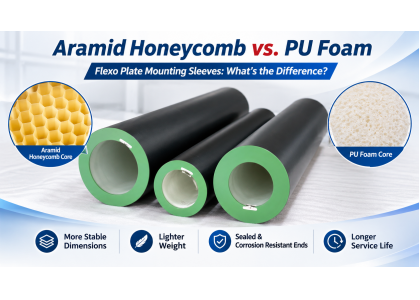
Flexo plate mounting sleeves play an important role in flexographic printing, especially in CI flexo presses and wide-web flexible packaging production.
Traditional plate sleeves commonly use polyurethane (PU) foam as their supporting core. However, under demanding production conditions, dimensional changes, sleeve weight and end damage can become concerns for printing companies.
To address these challenges, newer aramid honeycomb plate mounting sleeves use a different internal support structure.
But what are the actual differences between aramid honeycomb and conventional PU foam sleeves? And which design is more suitable for your printing operation?
Let's take a closer look.
Conventional flexo plate mounting sleeves use a multilayer composite structure, typically including:
• A polyurethane foam support core
• Glass fiber and synthetic resin reinforcement
• A composite inner base
• A rigid polyurethane outer surface
The PU foam layer provides structural support between the inner base and outer surface.
This construction is widely used in flexographic printing, but its performance depends on the material properties, sleeve design and operating conditions.
Over time, dimensional changes or damage to the sleeve ends may affect printing accuracy and require additional maintenance or replacement.
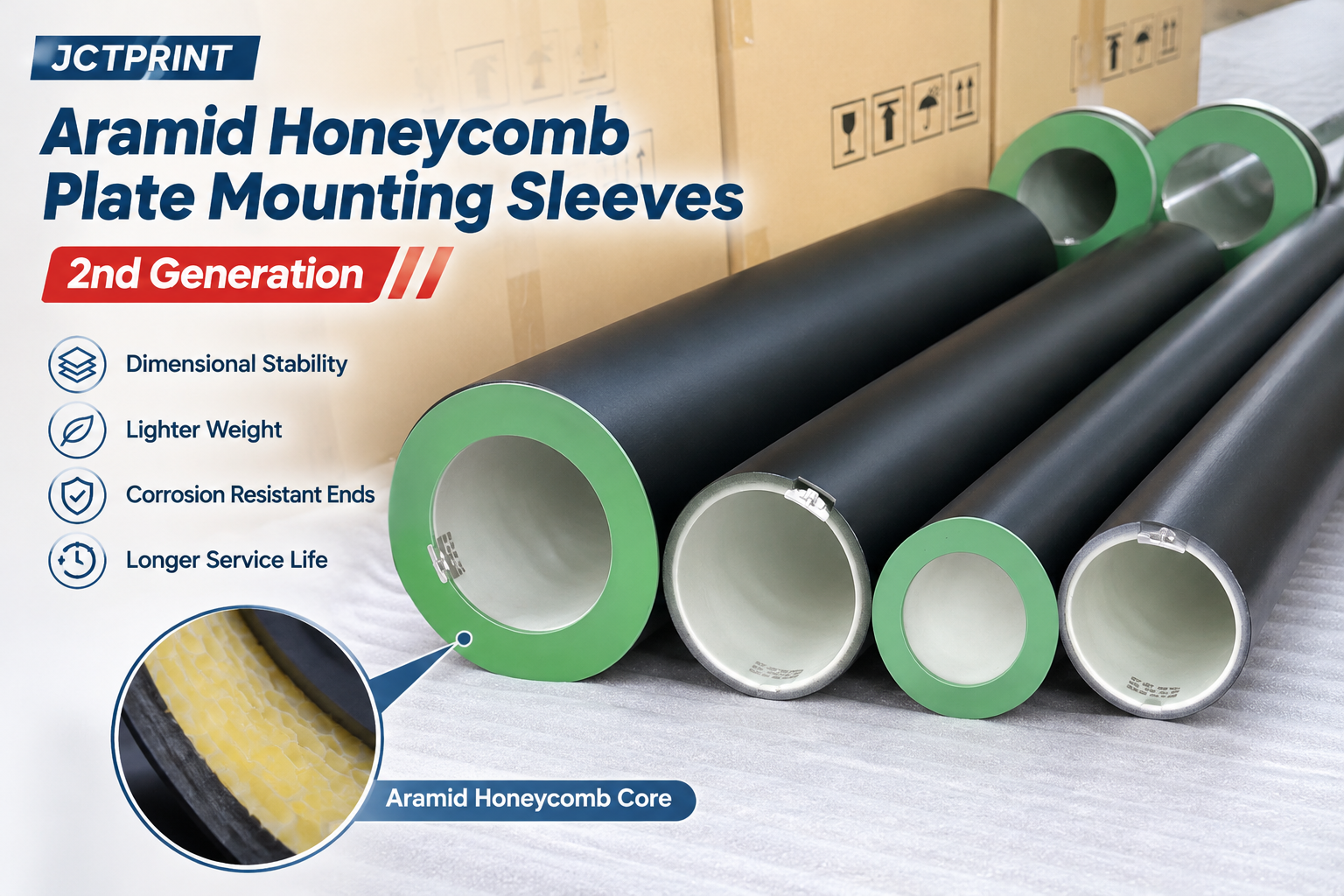
Aramid honeycomb sleeves replace the traditional PU foam support core with a lightweight honeycomb composite structure.
JCTPRINT's second-generation plate mounting sleeves combine several structural upgrades:
• Aramid honeycomb core: Provides lightweight, high-strength support.
• Composite reinforcement: Helps maintain structural stability.
• FiberP hybrid fiber inner base: Supports dimensional consistency and secure mounting.
• Polymer outer surface: Designed for compatibility with plate mounting tapes.
• Fully sealed polymer ends: Help protect the internal structure against impact and ink or solvent ingress.
Rather than changing only the core material, the second-generation design improves the overall sleeve construction.
| Feature | Traditional PU Foam Sleeves | Aramid Honeycomb Sleeves |
|---|---|---|
| Core material | Polyurethane foam | Aramid honeycomb composite |
| Structural support | PU foam support layer | Lightweight honeycomb with composite reinforcement |
| Inner base | Glass fiber and synthetic resin | FiberP hybrid fiber |
| Dimensional stability | Depends on PU foam and composite construction | Low-expansion core designed to improve stability |
| End protection | Separate impact protection | Integrated polymer ends with full sealing |
| Weight | Conventional composite construction | Potentially lighter, especially for thick-wall sleeves |
| Surface | Rigid polyurethane | Optimized polymer surface |
These structural differences can influence sleeve performance during printing, installation and long-term use.
Dimensional stability is particularly important in high-precision flexographic printing.
If a plate mounting sleeve expands or deforms, it may affect the printing repeat length and registration accuracy.
This can lead to:
• Increased registration adjustments
• Longer machine setup times
• Additional printing waste
• More frequent sleeve inspection or replacement
Aramid honeycomb materials offer relatively low thermal expansion compared with conventional PU foam core materials.
According to JCTPRINT's material reference data, the thermal expansion coefficient ranges are:
• Aramid honeycomb core: 0–20 ppm/°C
• Traditional PU foam core: 50–80 ppm/°C
These figures are reference ranges for the core materials, not measured expansion values for complete sleeves. Actual performance depends on material grade, construction and operating conditions.
Combined with composite reinforcement, the second-generation structure is designed to help maintain sleeve diameter and shape during production.
For CI flexo printers, improved dimensional stability can help reduce repeated setup adjustments and maintain more consistent printing conditions.
Sleeve weight becomes particularly important when working with long or thick-wall plate mounting sleeves.
Heavier sleeves can make installation, removal and job changes more demanding.
The lightweight aramid honeycomb core helps reduce the overall weight of certain sleeve configurations.
For one sleeve specification:
| Specification | Value |
|---|---|
| Inner diameter | 146.539 mm |
| Sleeve length | 1660 mm |
| Printing repeat | 680 mm |
| Radial wall thickness | Approximately 33.5 mm |
| Traditional sleeve weight | 19 kg |
| Aramid honeycomb sleeve weight | 11.7 kg |
Weight reduction: approximately 38.4%
That means approximately 7.3 kg less weight per sleeve in this specific comparison.
For printing companies with frequent job changes, lighter sleeves can reduce handling effort and make mounting and removal more convenient.
Actual weight savings vary depending on sleeve dimensions and construction.
Sleeve end damage is another concern in flexographic printing environments.
During installation, removal, cleaning and daily operation, sleeve ends may be exposed to mechanical impacts, ink and cleaning solvents.
If liquid enters the internal supporting structure, it may contribute to material deterioration and shorten the sleeve's useful life.
JCTPRINT's second-generation sleeves feature impact-resistant polymer ends integrated into the sleeve structure.
The fully sealed end design is intended to protect the internal core from ink and solvent penetration.
This can help reduce the risk of internal damage and support longer-term sleeve durability.
High-speed flexographic printing requires plate sleeves to maintain a secure and consistent fit on the mandrel.
JCTPRINT's second-generation sleeves use a FiberP hybrid fiber inner base manufactured through controlled winding and curing.
The structure is designed to support:
• Air-assisted sleeve mounting and removal
• Secure grip after air pressure is released
• Dimensional consistency
• Stable fitting during acceleration and deceleration
JCTPRINT has documented a flexographic printing application operating at 650 m/min.
This is an application reference rather than a guaranteed operating speed for every sleeve. Actual speed suitability depends on the press, mandrel, sleeve specifications and on-press verification.
For CI flexo and wide-web printing operations, secure mounting and dimensional stability are important factors when selecting plate sleeves.
Traditional PU foam sleeves may remain suitable for many printing applications, particularly where existing sleeve performance meets production requirements.
However, aramid honeycomb sleeves may be worth considering when your operation requires:
• Better dimensional stability
• Lightweight, thick-wall sleeve construction
• Improved protection against end damage
• Frequent plate changes
• Secure mounting for high-speed CI flexo applications
• Reduced maintenance and replacement requirements
The best choice depends on your printing machine, sleeve dimensions, operating conditions and production priorities.
Rather than selecting a sleeve based on material alone, it is important to confirm its complete construction and compatibility with your equipment.
JCTPRINT manufactures customized flexo plate mounting sleeves for CI flexographic printing and other flexo applications.
Our second-generation aramid honeycomb sleeves combine lightweight core materials, composite reinforcement, a FiberP inner base and fully sealed polymer ends.
Available customization includes:
• Outer diameter: Φ63–Φ575 mm
• Printing repeat: 200–1800 mm
• Sleeve length: 300–3000 mm
• Radial wall thickness: 1–100 mm
• Customized register features
• Optional antistatic versions
Sleeves can be manufactured according to your mandrel dimensions, printing repeat and other technical requirements.
If you are considering replacing conventional PU foam sleeves or upgrading to aramid honeycomb plate mounting sleeves, JCTPRINT can help review your requirements.
Send us your machine model, sleeve dimensions, printing repeat or technical drawing.
Our team can help confirm the appropriate sleeve specifications and provide a customized quotation.
Contact JCTPRINT to learn more about our second-generation aramid honeycomb plate mounting sleeves.


